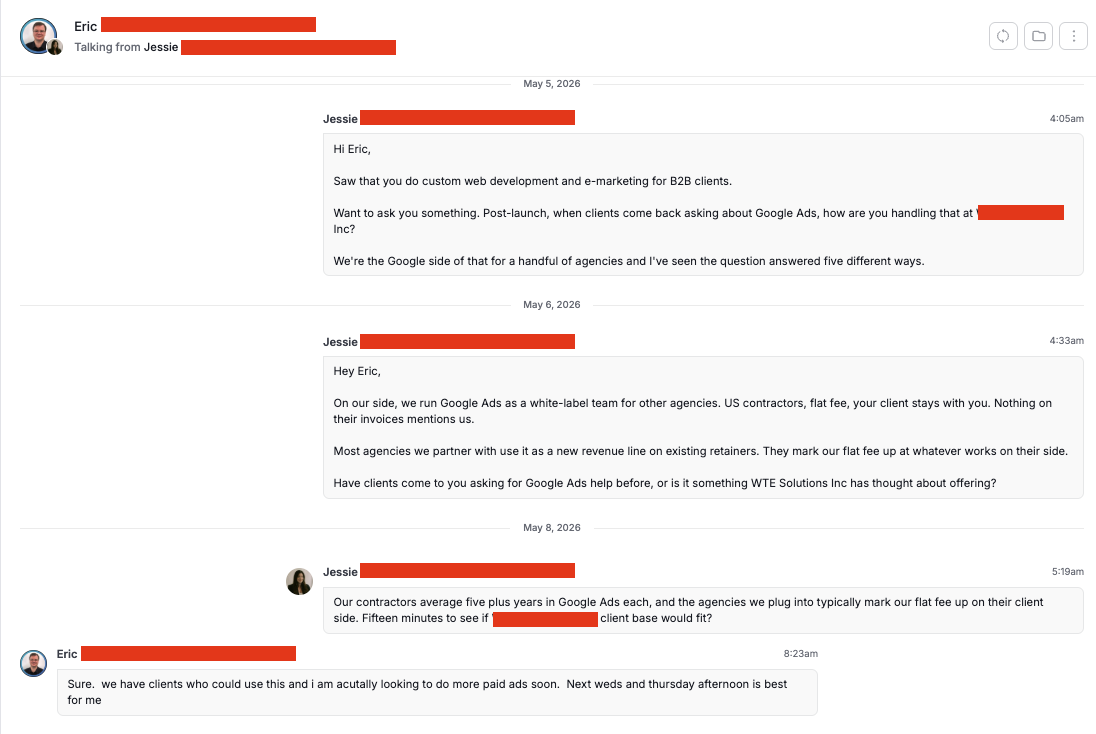
What does Growlancer actually do?
Start here. A 90-second walk-through of what we are, what we do, and how we do it.
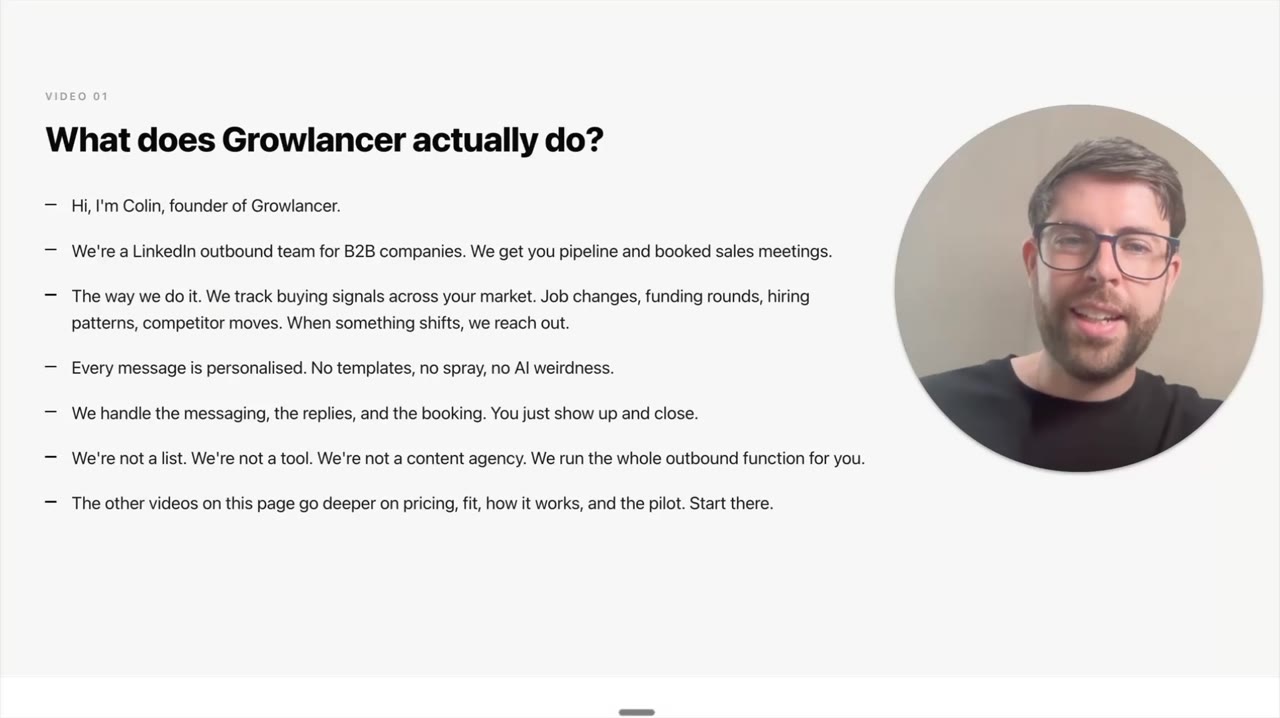
I wanted to make a few short videos to walk you through what we do, so when we get on a call we can skip the basics and get into the actual conversation.
In short: we're a LinkedIn outbound team for B2B companies. We get you sales pipeline. Actual booked meetings on your calendar, ready for your team to close.
The way we do it. We track buying signals across your market, scraping the information that tells us who's looking to buy right now, or might be soon. Then we go deep on qualification, who your real target market is and isn't, so we're only reaching out to the right people. Every prospect gets researched. Every message gets personalised.
No templates. No spray-and-pray (unless there's a tactical reason to widen the net for a specific client). We also keep AI out of the messages themselves. AI helps us find the right information fast, but the writing's ours.
We handle the messaging, the replies, and the booking. You just show up and close, whether that's you, your head of sales, or your team.
We're not a LinkedIn automation tool. We're not a content agency. We run the whole outbound function for you.
The other videos on this page go deeper on pricing, how it works, and the free pilot we run to get started. Watch through and I'll see you on the call.
Will this work for my company?
An honest run-through of who Growlancer works for, who it doesn't, and where the line is.
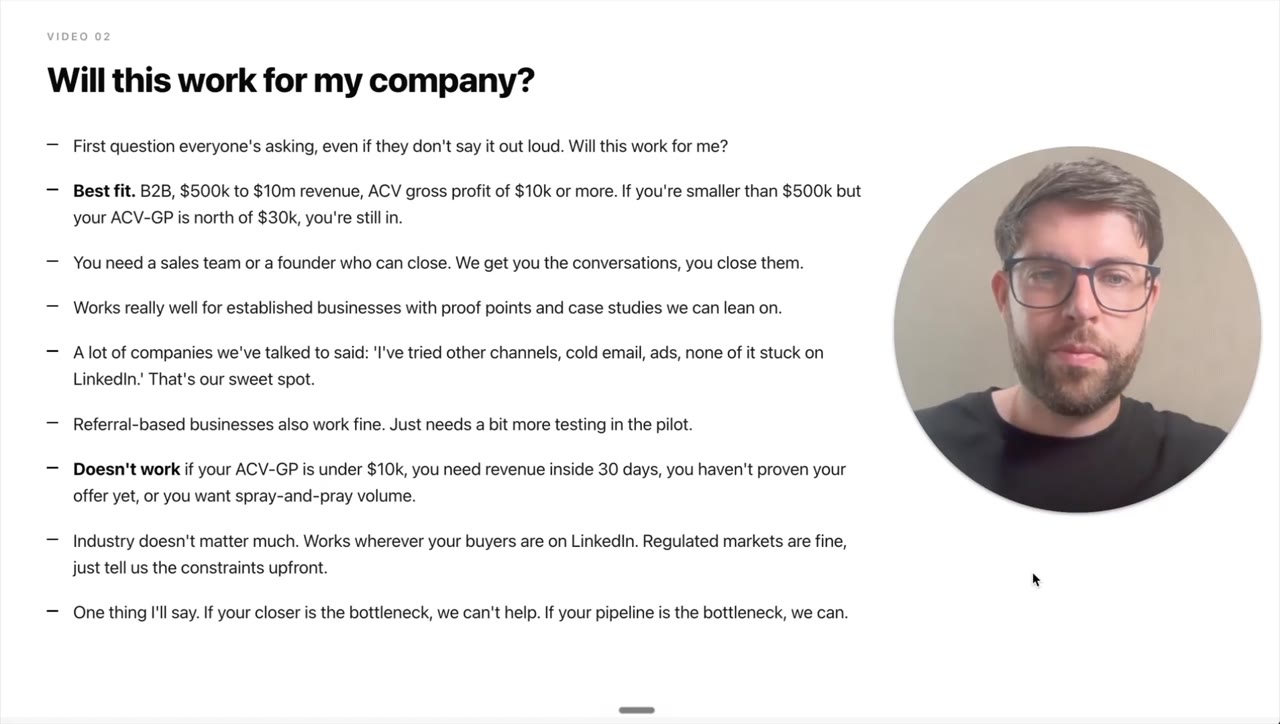
Our best fits are B2B. You sell to other companies, you know who you're going after, and you've got some kind of track record with them. Case studies are ideal. You don't need to name names if you're under NDA, we just need to see you've done the work in a specific industry.
The economics that make this work: typically $500K to $10M in revenue, and an ACV gross profit over $10K (what you keep from a customer over their lifetime). Below that, outbound as a channel is hard to make work unless you're running it in-house. Above $10M, clients often take it in-house, and we've helped a few do exactly that when they were ready to hire.
You also need a sales team that knows its numbers, or a founder who can close. If a lead lands in your pipeline and nobody can tell me your close rate from that point, we're probably not the right partner. We get you into conversations with ideal customers who need to buy now or soon, and we book the meetings. From there it's on you.
Our sweet spot is well-established businesses with proof points. Most have tried cold email, ads, maybe some content. Some of it worked, none of it scaled on LinkedIn. The business runs on referrals or another channel, but LinkedIn never clicked. That's where we come in and tackle the low-hanging fruit fast.
Referral-based businesses work fine too, as long as there's a track record to build on. Industry doesn't matter much, as long as you're clear on who you're going after.
What doesn't work: ACV gross profit under $10K, or you need revenue this month. The pilot takes a week, then we move into a 90-day window because there's real learning in the first stretch.
If your closer is the bottleneck, we can't help. If your pipeline is the bottleneck, we can.
How does it actually work?
The five steps of every Growlancer campaign, in plain English.
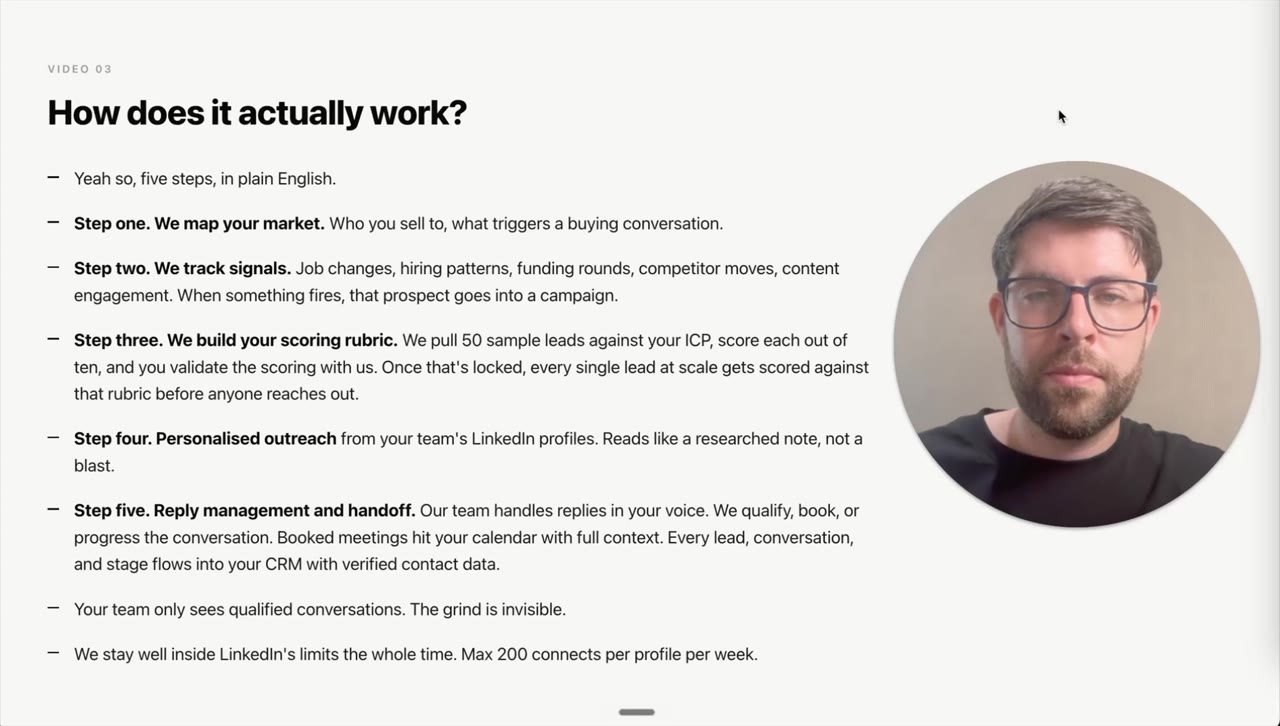
We start by connecting the LinkedIn profiles of three people in your business. The reason for three is volume. We want you getting into new conversations with qualified people every single day, and three profiles is what it takes to hit a meaningful number.
It's usually you plus some sales support. It honestly doesn't matter who. If you don't have the people, we can help you get access to other profiles. Don't let that be a stumbling block.
From there it runs through our five-step process.
Step 1. Map the market. We sit down at the start of the engagement and work out every sub-segment you can target into. Where do you have the most social proof, the strongest results, and the sharpest value proposition? That's where we point the campaigns first.
Step 2. Track the signals. We could reach out to all 150,000 people in your market, but only about 5% actually need what you're selling right now. Maybe they're in a new role. Maybe they just rolled out a new technology, commented on a relevant post, or posted a job. If they're showing intent, they become top priority.
Step 3. Build your scoring rubric. We pull a sample of 50 leads, score them out of 10, and send them to you. You tell us where we got it right and where we got it wrong. We iterate until the rubric is nailed on. From that point, 99% of leads hitting your campaigns are properly qualified, unless our systems have a bad day, which generally hasn't happened yet.
Step 4. Personalised outreach. The same research that powers scoring also powers the messages. Every single person gets a different message. No two are the same, and it's not just swapping the first name. We pull from their LinkedIn, their content, recent case studies on their site. If we spoke to John last week and now we're reaching out to Mary in the same business, we reference it. It reads hands-on because it is.
Step 5. Reply management and handoff. We sit in your inbox during US hours and late European hours, and cover Australia too. We respond to conversations as they come in, often within five minutes during working hours. We take them right up to a booked meeting on your calendar. You take it from there.
Your team only sees the qualified conversations. Everything's stored in a database, and we report on it weekly so you can see progress and ROI on a live basis.
How much does it cost & what's the ROI?
Pricing, the SDR comparison, the DIY-stack comparison, and the gross-profit math.
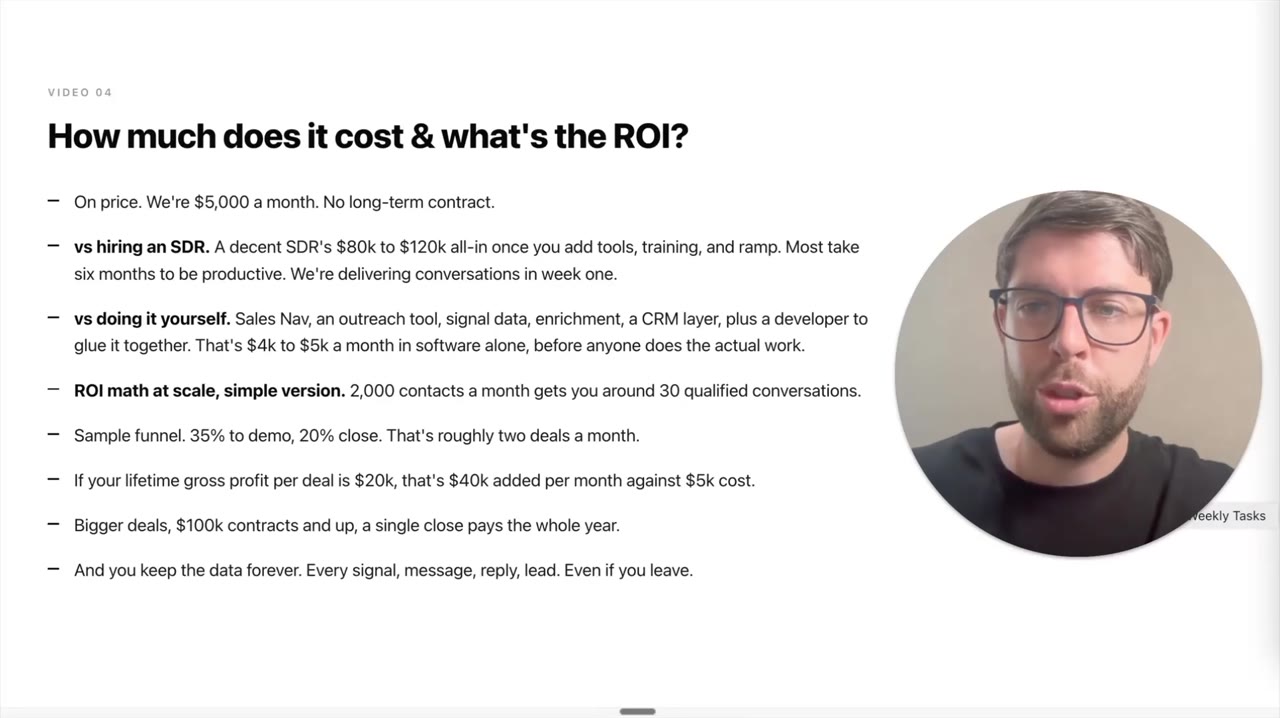
Here's how the cost and ROI math actually works.
Pricing is $5K per month, no long-term lock-in. We run an initial 90-day period after the free pilot, then it goes monthly rolling. We usually make an offer for a 12-month lock-in around that point, but that's a decision to make down the road, not today.
Compare that to hiring an SDR. A decent one in the US, UK, or Australia runs $80K to $120K all-in, before training and ramp. Many take months to become productive. We're booking meetings in week one for less than that.
If you're thinking you can just do this yourself, cancel the call and go do it. You're probably not our fit. The tools exist. The real cost is the opportunity cost of your time, and the quality of work that comes off the back of someone doing it full-time as their craft.
The ROI math at scale, simple version. We run 200 contacts in the pilot. The goal is roughly 3 qualified conversations, enough to prove the system works. From there we scale volume by 10x in the normal agreement, so we're looking at 30 qualified conversations a month minimum.
Sample funnel: book 35% of those into a demo, so 10 demos a month. This varies a lot. With more volume we can double the meetings, and reply-to-demo rates can run higher. Let's stick with 10 to keep it conservative.
Close 20% of that and you've got roughly 2 deals a month. If your lifetime gross profit per deal is $20K (not contract value, so a $100K contract with $20K in lifetime gross profit), that's $40K of gross profit added in a single month against our $5K cost. Bigger deals scale the math up considerably.
One more thing. All the connections, conversations, and signal data we build, you keep forever. Whenever we wrap up, or you take it in-house, you walk away with every connection on LinkedIn, every conversation logged, and the full database. The asset stays with you.
What happens in the free pilot?
Two weeks, real campaign, no obligation. Here's exactly what we do and what you'll see.
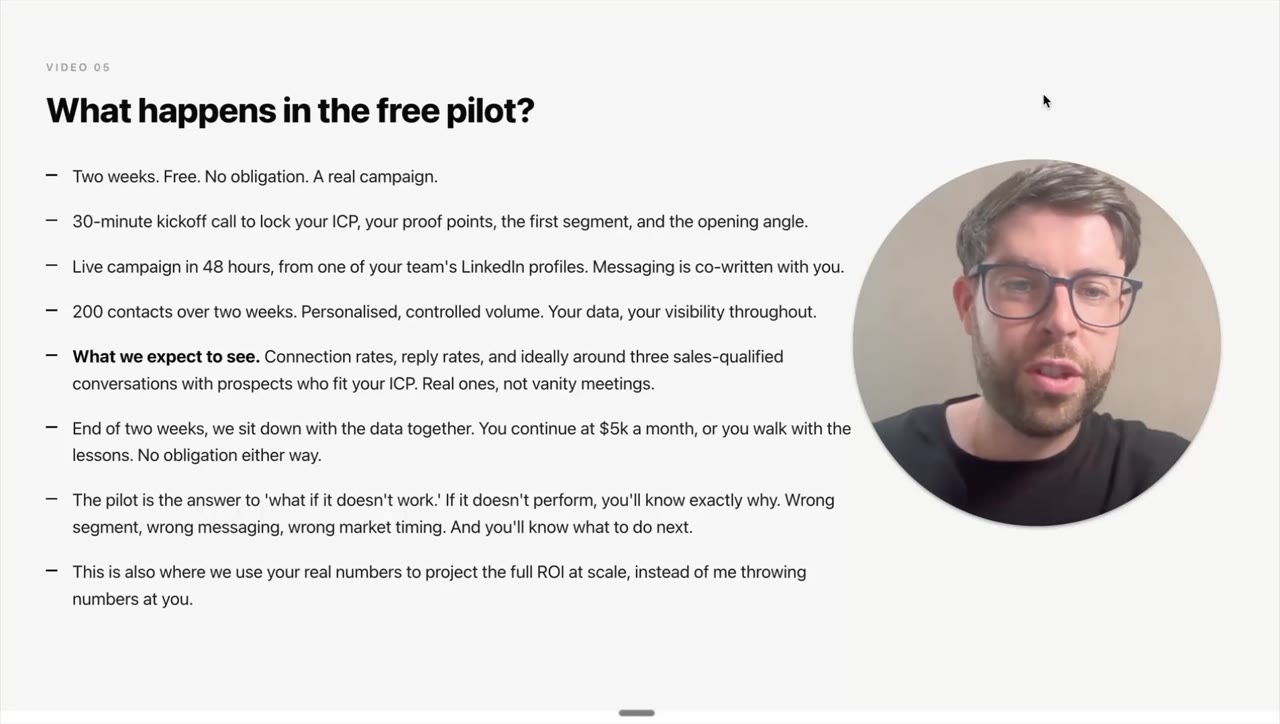
The first step in working together is a free pilot. We run an actual LinkedIn campaign through one profile (probably yours, the person watching this) to 200 contacts. The whole point is to prove this works on your market, not in theory.
It plays out over 7-10 working days. Before we launch, I need a 30-minute call with you to lock in your ICP. I'm looking to build relationships with people who want to grow this channel over the long term, so the targeting has to be sharp from day one.
We can have the campaign live within 48 hours of that call. You get connected to our LinkedIn sending software, we write the messaging, we build the list, and the 200 contacts go out over the next 7-10 working days. Every message is personalised so you can see exactly what good outbound looks like on your audience.
What we're aiming for is roughly 3 sales conversations with qualified leads during the pilot. That's the win condition. Not to help you close a deal (your sales cycle is probably longer than two weeks), but to show that the campaigns can get you in front of the right people.
We don't manage your inbox during the pilot. We just send the initial campaign. Once we move into a paid engagement, we run the inbox too.
The pilot exists to answer one question: what happens if it doesn't work? If it underperforms, you'll know exactly why, and you'll get honest feedback. Plenty of the pilots we've run in the past have failed, and almost always for the same reason: the company hadn't nailed the messaging yet. When that's the case, there's pre-work we can do together to fix it before we go again.
If you're unsure whether your messaging is dialled in, that's worth a conversation in itself, assuming you fit the rest of the criteria.
By the end of the pilot you'll have 200 contacts touched, real reply data, and the questions answered. From there we can run the ROI projection (the same one in the previous video) so you can make a clean decision: is this worth investing in for the long term, and do you trust my team to run it for you?
Why can't I just do this myself?
The honest answer. If you can, you should. Here's what we bring that the tools don't.
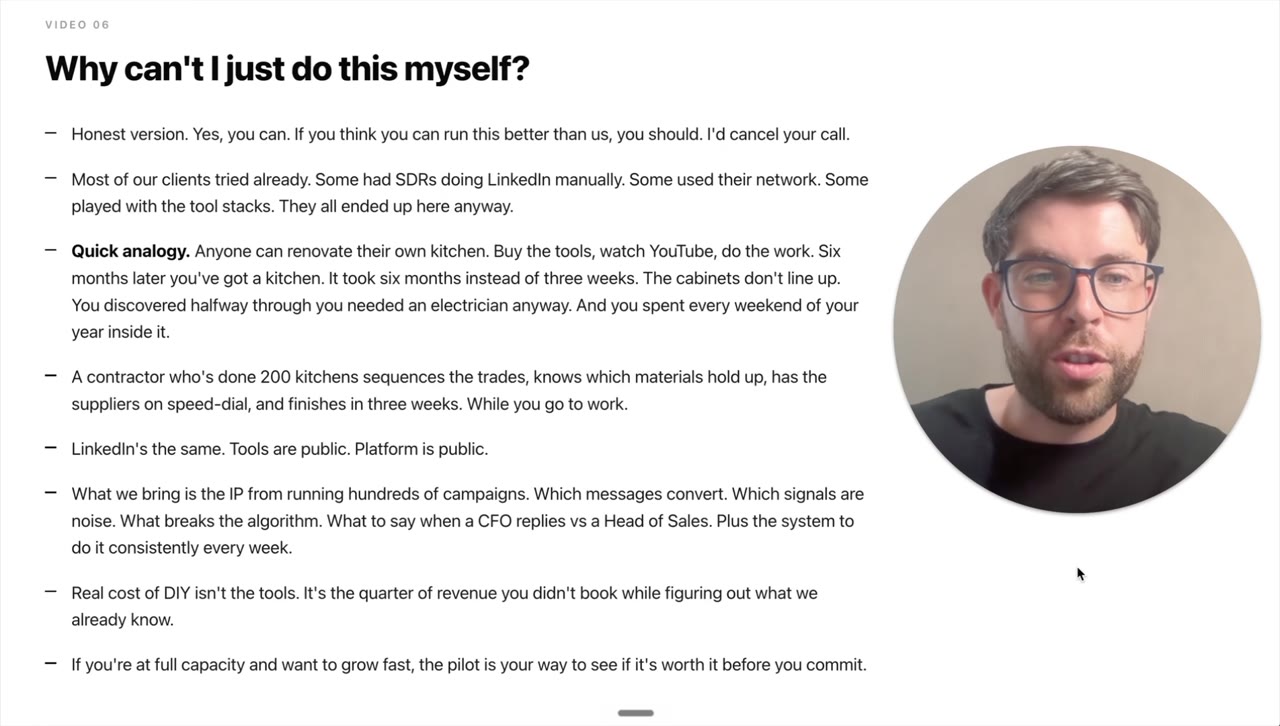
If you're sitting there thinking "why can't I just do this myself?", my honest answer is you should. If you think you can run this better than us, you should. I'd cancel your call.
Most of our clients could do LinkedIn. They had. Some had SDRs running it manually, some had fired off DMs into their network, some had tried the tools and got it half-working. They all ended up working with us anyway.
Here's the analogy I keep coming back to. Anyone can renovate their own kitchen. YouTube will show you the materials, the tiling, the electrics, all of it. You can absolutely do it. It'll just take you three times as long, look like a kitchen you installed yourself, and you'll probably end up paying a builder the same money to fix it. Same result, much longer road.
A contractor who's done 200 kitchens gets it right first time. They'll tell you where to save money on materials, and they bring expertise you don't have because they've done it before.
What we bring is IP from running hundreds of campaigns across pretty much every B2B niche, iterated down to messages that actually convert. We know which signals work and which don't, and the obvious one isn't always the right one. We know how to build offers. We know what to say to a CFO versus a head of sales versus a chief revenue officer versus a marketing director. They all need different messages because they all think differently about what you're selling.
The real cost of DIY isn't the tools. It's the quarter of revenue you'll miss out on doing it yourself.
If you've got the time and capacity in your team and you want a crack at it, go for it. Rebook in 90 days if it doesn't work. If it does, fair play to you.
But if you're at capacity, you need more leads, and you want to grow, we're looking for partners for the long term. The pilot is how you find out if we're made of what we say. Book a time in. I'd love to chat.
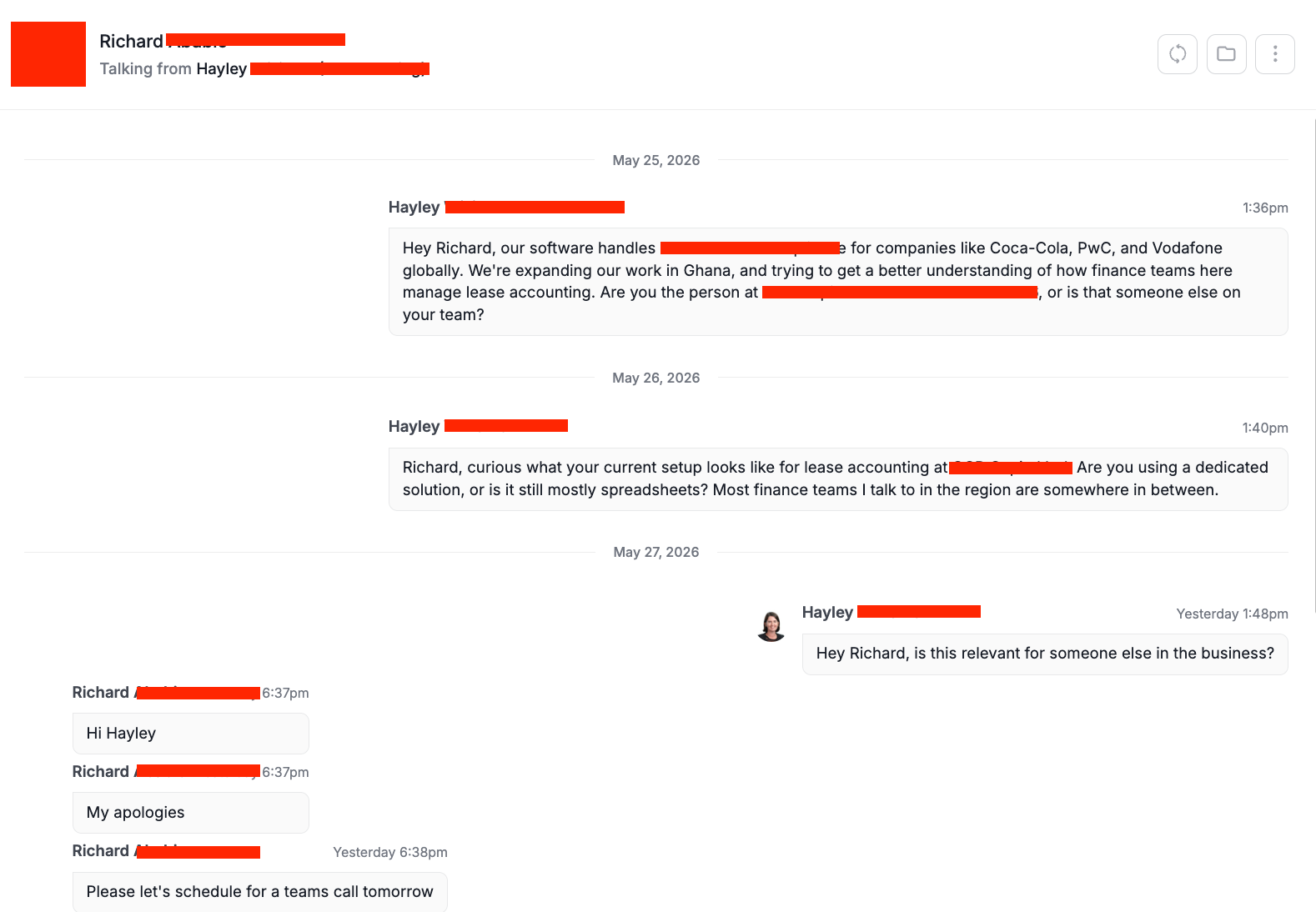
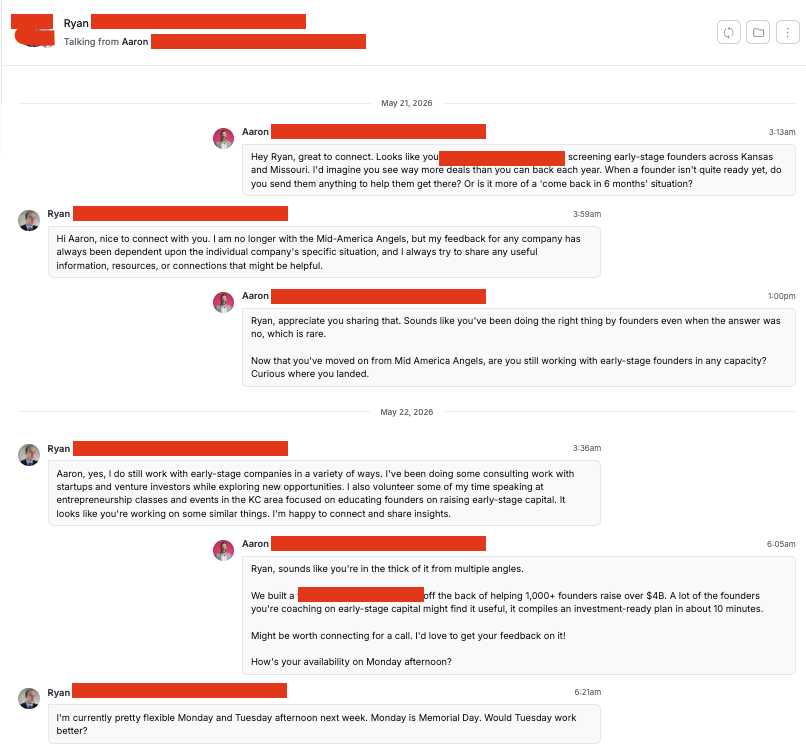
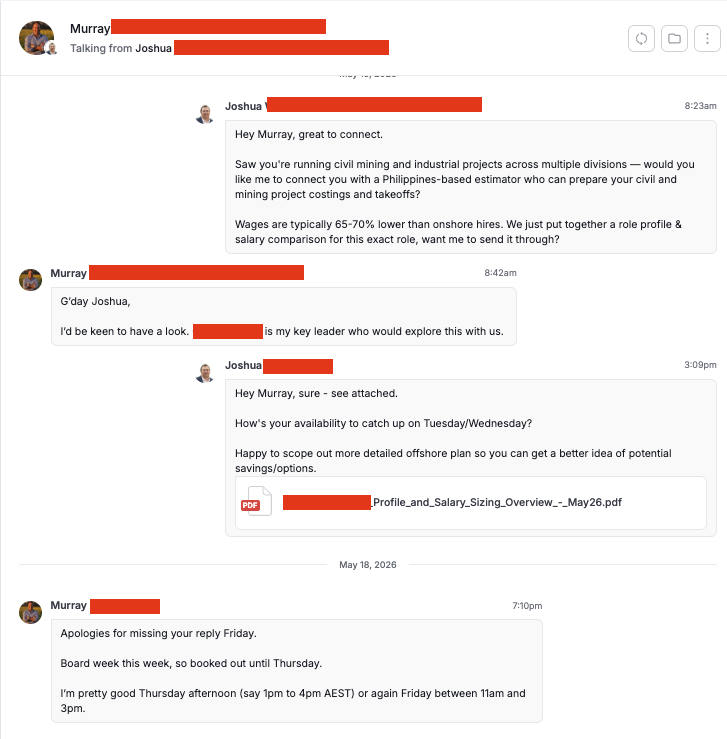
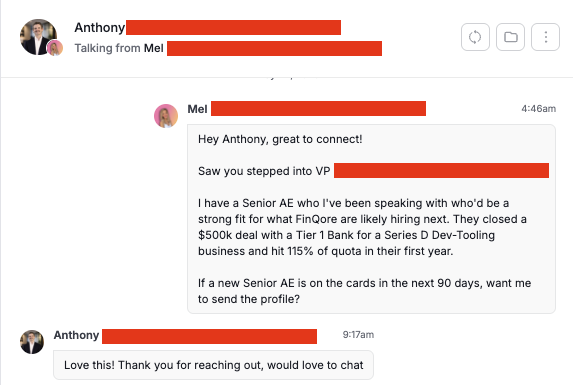
Can I see some examples of your messaging?
A walk-through of five real campaigns from current clients. Different industries, different angles, same approach. Hit "Read more" below the video to see the raw threads alongside the playbook notes.
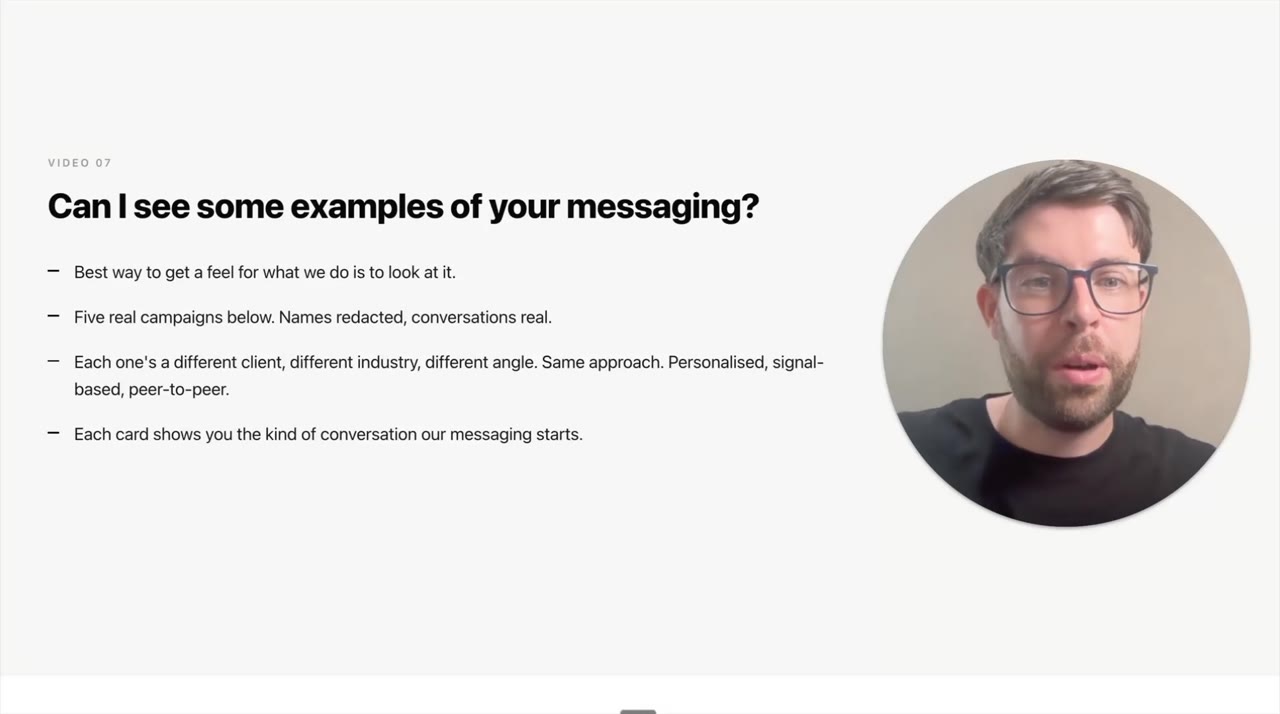
Most people on LinkedIn worry about an agency coming in, sending generic templates, and burning their brand. So below this video are five real conversations we ran for clients across very different niches. Pause and read them in full. The screenshots tell the story better than I can.
What I want to flag is the common thread running through all of them, because that's the actual playbook.
None of these open with "book a demo." They open with a soft question or an observation about the person's business. We're trying to start a conversation, not pitch a meeting. If someone doesn't reply on message one, that's fine. The follow-up adds context, not pressure.
You'll also notice we hold social proof back. Big names get dropped at the right moment, mid-thread, once the person is engaged. Leading with "I'm great" kills the reply rate. Earning the right to share it doesn't.
In the staffing and recruitment examples, the entire flow is built around offering a piece of collateral (a role profile) so the prospect just has to say "yes, send it." That's a deliberate handoff mechanic. We pre-build the collateral with the client so the team can send it instantly. Low friction, fast hand-raise, then a call.
This is the pre-work nobody sees. Before a pilot starts, we spend real time with the client designing the offer itself. Cold outreach is different from referrals. Referrals come in 1 out of 10 warm. We have to take them from a 1 to a 6 or 7 in a few short messages. The offer is what does that work.
Read the messages below with that lens, and the structure becomes obvious.
Lease Accounting Software Campaign
AI Fundraising Tool Campaign
Offshore Staffing Campaign
Senior Sales Recruitment Campaign
White-Label Google Ads Campaign